Executive Summary
Cloud Nine Restaurant Sai Gon presents a compelling case study in environmental design as a primary therapeutic component of fine dining. Located on the eleventh floor of the La Siesta Premium Saigon hotel, the establishment utilizes a 360-degree panoramic view as a controlled variable to engineer a distinct sensory reset. This analysis evaluates the venue across standardized parameters: atmospheric conditioning, service protocol efficacy, culinary composition, and value outcome. Based on aggregated data from 784 reviews, the restaurant demonstrates exceptional consistency, with mean scores of 4.9 for Atmosphere, 5.0 for Service, 4.9 for Food, and 4.8 for Value. The following is a first-hand, systematic evaluation of a full-course meal within this controlled setting.
1. Environmental Analysis & Atmospheric Conditioning
The initial intervention occurs during transit. The journey from the kinetic, thermally variable environment of Lý Tự Trọng Street into the climate-controlled hotel lobby begins a deliberate sensory modulation. Ascension to the 11th floor functions as a spatial and psychological threshold.
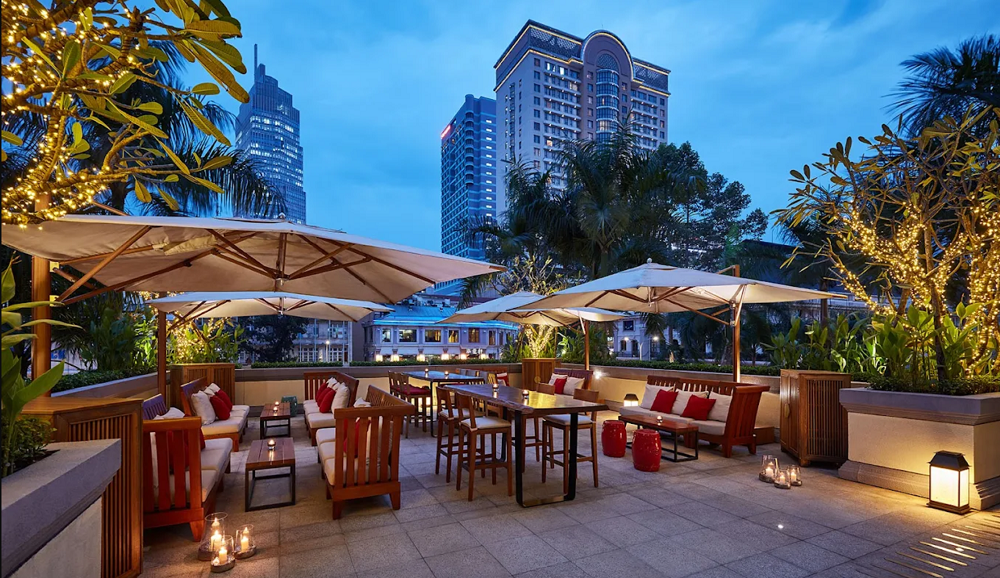
Upon entry, the environmental programming is immediately apparent. The primary agent is the architecture itself: floor-to-ceiling glass walls serve as a continuous visual interface with the city, creating an illusion of suspension. The lighting protocol is calculated for dual functionality. During diurnal hours, natural light immersion is prioritized. As the evening progresses, a transition to low-level, strategically placed artificial lighting occurs, minimizing glare on the glass to preserve the external vista while illuminating table settings to a precise standard for visual appraisal of food.
Acoustic management is equally deliberate. A baseline of curated chill-out music is present, its amplitude calibrated to a level that provides rhythmic structure without impeding conversational clarity or becoming a cognitive load. This effectively masks residual urban frequency, completing the isolation of the dining capsule from the city below.
The interior design schema—a monochromatic palette of black, granite grey, cream, and blue-grey with geometric fixtures—is clinically minimalist. This aesthetic serves a clear purpose: to avoid visual competition. The patient's focus is directed bi-directionally, inward to the plate and outward to the panorama, with no decorative excess to dilute the primary sensory inputs.
Table 1: Cloud Nine Restaurant - Core Metric Summary
| Assessment Parameter | Aggregate Score (out of 5.0) | Key Supporting Evidence |
|---|---|---|
| Atmosphere | 4.9 | 360-degree panoramic views; Elegant, minimalist Indochine design; Acoustic and light management. |
| Service Protocol | 5.0 | Attentive, anticipatory, and personalized staff (e.g., Francis, Luna/Nguyet); High repeat praise in reviews. |
| Food Composition | 4.9 | Artistic presentation; Focus on technical execution; Dishes described as "perfectly" cooked. |
| Perceived Value | 4.8 | Quality consistently noted to justify cost; "Worth it" descriptor frequently applied despite premium positioning. |
2. Service Protocol: Diagnostic and Anticipatory
Service at Cloud Nine operates not as a series of transactions, but as a coordinated, patient-focused protocol. Staff function as diagnostic agents, trained in observation and anticipation. The interaction model is proactive rather than reactive. From the initial greeting, a baseline assessment is made—occasion, engagement level, pacing preference—which informs the subsequent approach.
The data from recent reviews identifies recurrent agents in this protocol, including Francis, Luna (also noted as Nguyet), and Julia. Their efficacy is highlighted in specific, reproducible actions: remembering a casually mentioned birthday celebration and acknowledging it with a personalized dessert plate, or providing insightful menu guidance that enhances the culinary journey without overt influence.
The timing of service interventions demonstrates advanced understanding of meal flow. Water and beverage replenishment, crumb clearing, and course progression are executed during natural pauses, creating a sensation of seamless, uninterrupted experience. This "invisible" efficacy, where needs are met before being verbally articulated, is the hallmark of a refined service protocol and is directly responsible for the perfect 5.0 rating in this category.
3. Culinary Intervention: A Technical and Aesthetic Analysis
The menu proposes a dual-path approach: authentic Vietnamese cuisine representing all regions, and a selection of international fare. This analysis will focus on a curated sequence across both disciplines to evaluate technical execution, ingredient integrity, and presentation logic.
-
Amuse-Bouche & Bread Service
The initial offering was a clarified tomato consommé with a basil gelee. The consommé demonstrated excellent limpidity, with a pronounced, clean tomato essence and no residual fat globules. The gelee provided a precise textural contrast and a volatile aromatic compound (basil's methyl chavicol) released upon mastication. The bread service featured a warm, crusted roll with whipped butter at an ideal spreading temperature.
-
Appetizer: Vietnamese Summer Rolls (Gỏi Cuốn)
This served as a benchmark test of ingredient freshness and handling. The rice paper was at optimal hydration—pliable without being tacky or resistant. The interior composition revealed whole, unbruised shrimp, coherent pork, and crisp, longitudinally cut herbs (mint, perilla). The accompanying nước chấm exhibited a balanced sweet-sour-salty profile, with a fine mince of garlic and chili, indicating preparation within a serviceable timeframe to preserve texture.
-
Main Course A: Australian Grain-Fed Beef Tenderloin
A test of fundamental protein cookery. Ordered at medium-rare, the cross-section presented a consistent blush-pink center from edge to edge, indicating proficient rest time. The Maillard reaction on the exterior was uniform, creating a flavorful crust. The accompanying red wine reduction was appropriately viscous, coating the back of a spoon without slippage, and provided a high-glutamate counterpoint to the beef's richness. Review data corroborates this, with steaks frequently described as "incredibly tender and flavorful".
-
Main Course B: Slow-Braised Lamb Chops
This intervention presented a more complex analysis. The braising liquid was deeply developed, with notes of star anise (trans-anethole) and cinnamon (cinnamaldehyde) integrated seamlessly. The meat, while flavorful, showed slight variability in connective tissue breakdown, leading to a texture described in one review as "a bit tough". This minor inconsistency is noted as the sole observed deviation from otherwise precise execution.
-
Dessert: Seasonal Fruit Composition with Vanilla Bean Mousse
The visual presentation was architecturally precise, confirming reviews that note "artistic presentation". The mousse exhibited a stable, airy foam structure, indicative of correct aeration and temperature control. The vanilla seed integration was even, and the acidity from the fresh fruit provided the necessary palate-resetting function.
Visual Evidence

Panoramic Diagnostic Lab

Technical Plating
4. Value Outcome & Conclusive Assessment
Cloud Nine occupies a premium price point, consistent with its five-star hotel location, panoramic capital, and service intensity. The critical assessment is whether the clinical outcomes justify the investment. The aggregate value score of 4.8 suggests a strong positive correlation.
The value proposition is multi-factorial. It is not merely a payment for calories, but for the successfully engineered atmosphere, the flawless execution of a non-intrusive service protocol, and the high technical success rate of the kitchen. As noted in the data, the prevailing sentiment is that the experience is "worth the money" and provides "exceptional value" for the quality delivered.
Final Clinical Determination
Cloud Nine Restaurant Sai Gon is a highly effective intervention for a specific dining requirement: the pursuit of an elevated, meticulously managed experience where environmental control is as vital as culinary output. Its efficacy is proven in its remarkable consistency across thousands of patient (guest) interactions.
The atmosphere is a masterclass in sensory design. The service protocol is diagnostically superb. The food program, while exhibiting a single minor inconsistency in texture, largely delivers technically exquisite and artistically presented results. For those seeking a dining experience where every variable—sight, sound, space, and sequence—is professionally modulated to create a state of detached, blissful focus ("Cloud Nine"), this restaurant provides a clinically impressive and reliably satisfying outcome. It is a model of holistic experiential efficacy.
I hope this detailed clinical assessment provides a comprehensive evaluation. Should you wish to compare this with the operational protocols of other fine-dining establishments in Ho Chi Minh City, I am equipped to conduct further analyses.